

Mass Spectrometer
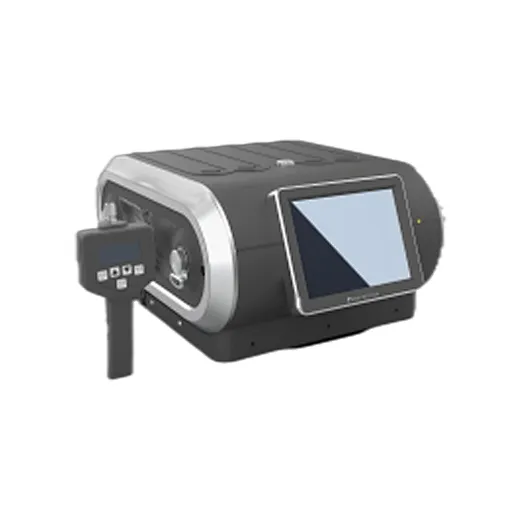
Portable Gas Chromatograph-Mass Spectrometer
The portable Gas Chromatography–Mass Spectrometry (GC-MS) system is designed for rapid, on-site detection and analysis of volatile organic compounds (VOCs) and semi-volatile organic compounds (SVOCs) with high accuracy. Its compact, lightweight design allows convenient deployment in backpacks, vehicles, and mobile monitoring units. The system supports real-time environmental monitoring, pollution source identification, and trace-level chemical analysis for applications involving atmospheric studies, groundwater testing, soil remediation, industrial safety, and emergency response.
Application
Compact, lightweight, and portable design for field deployment.
Built-in industrial PC for integrated system operation.
One-click VOC analysis for rapid testing.
Supports Total Ion Chromatogram (TIC), Total Ion Monitoring (TIM), chemical warfare agent (CWA), and SVOC detection.
Wide mass range for comprehensive compound analysis.
Heated transfer line for improved sample transfer.
PPM-to-PPB detection capability for trace-level analysis.
Compatible with sample loops and thermal desorption systems.
Built-in compound library with automatic data matching.
Unknown compound identification and custom library support.
Automated data analysis with TIC and Extracted Ion Chromatogram (EIC) displays.
Background subtraction and baseline correction.
Supports continuous operation for up to 24 hours.
Compatible with gas probes, liquid injectors, headspace samplers, and Solid-Phase Microextraction (SPME) modules.
Compact, lightweight, and portable design for field deployment.
Built-in industrial PC for integrated system operation.
One-click VOC analysis for rapid testing.
Supports Total Ion Chromatogram (TIC), Total Ion Monitoring (TIM), chemical warfare agent (CWA), and SVOC detection.
Wide mass range for comprehensive compound analysis.
Heated transfer line for improved sample transfer.
PPM-to-PPB detection capability for trace-level analysis.
Compatible with sample loops and thermal desorption systems.
Built-in compound library with automatic data matching.
Unknown compound identification and custom library support.
Automated data analysis with TIC and Extracted Ion Chromatogram (EIC) displays.
Background subtraction and baseline correction.
Supports continuous operation for up to 24 hours.
Compatible with gas probes, liquid injectors, headspace samplers, and Solid-Phase Microextraction (SPME) modules.
Feature
L1. Petrochemical Industry
Online monitoring of reactants and volatile organic compound emissions in petrochemical facilities.
Analysis of molecular composition and distillation-range distribution during production.
Monitoring of residual gases and detection of pipeline leaks.
Identification and analysis of industrial chemical emissions.
2. Fire Protection and Emergency Response
Rapid detection of toxic, hazardous, flammable, and explosive gases at fire scenes.
Monitoring of toxic gas leaks and hazardous chemical releases.
Support for post-disaster investigations and evidence collection.
3. Public Safety and Occupational Health
Indoor air quality assessment.
Workplace air quality monitoring.
Detection of hazardous chemical vapours.
Occupational exposure assessment and industrial safety analysis.
4. Chemical Defence and Military Applications
Detection and identification of chemical warfare agents, including nerve agents such as sarin and blister agents such as sulfur mustard.
Chemical hazard reconnaissance and field monitoring.
Potential integration into specialised chemical defence and reconnaissance vehicles.
5. Aerospace Applications
Detection of fuel leaks, including hydrazine and unsymmetrical dimethylhydrazine.
Analysis of cabin air quality in spacecraft.
Monitoring of environmental contaminants in aerospace facilities and space-related environments.
6. Environmental Monitoring
On-site detection of VOCs and SVOCs in air, water, soil, and solid samples.
Atmospheric pollution monitoring and environmental assessment.
Groundwater contaminant analysis.
Soil investigation and remediation monitoring.
Identification of oil spill sources and chemical contamination.
Rapid chemical analysis at environmental accident and pollution incident sites.